Cast: John Amplas,
Lincoln Maazel, and Christine Forrest
Director: George A. Romero
95 minutes (18) 1977
Second Sight 4K Ultra HD
[Released 27th March]
Rating: 8/10
Review by Max Cairnduff
George
A. Romero is best known for his zombie movies. Apparently, though, his own
favourite among his films is the less well known Martin. Having now watched it (for the first time) I can see why he’s
so taken. It’s an exceptional work that’s bleak, sad, disturbing, and
challenging.
John
Amplas plays the eponymous Martin. When the film begins he’s on a train to
Pittsburgh. He sees an attractive fellow passenger who has paid for an
overnight cabin. He fantasises about her inviting him in and making love to
him. The reality is that he rapes and murders her. The woman struggles to
escape, but is drugged unconscious and Martin then drapes her arms over him as
if she were reaching for him in passion. Eventually he slits her wrist and
drinks from it.
That’s the first five minutes of the film. Already the viewer can see that Martin is a rapist, a murderer, and a deluded fantasist. The question though is whether that’s all he is or whether he’s also a vampire.
When
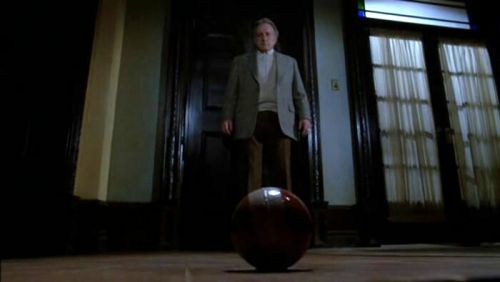
the train pulls in, Martin is greeted by elderly relative Tada Cuda (Lincoln
Maazel), in whose house he will be staying. The house is festooned with garlic
and crucifixes, and Cuda explains to Martin that he will save him then destroy
him but that, if he feeds on the people of the city, he will destroy him
without saving him. Cuda also warns Martin not to speak to the other person who
lives in the house, Martin’s cousin Christina (Christine Forrest). Cuda clearly
believes Martin is a vampire, even addressing him as ‘nosferatu’. Christina’s
view is that Martin is simply mentally ill and that Cuda is making it worse.
I’m
obviously not going to repeat the whole plot here. The above is merely the set-up.
The question this raises is whether Martin is a profoundly psychologically-damaged
teenager who is enabled in his fantasies by an ageing relative’s belief in
them, or whether he is as he and Cuda believe: an 84-year-old who has kept
young by drinking the blood of others.
There
are hints in the film that Martin may be just what he says he is. Cuda refers
to others in the family similarly afflicted; suggesting a genetic condition
which Martin may have inherited. Cuda is keen that Christine does not have
children in case she carries the condition silently within her. Cuda, though,
is not reliable. He believes too in the old superstitions, in garlic and
exorcism but as Martin says to him again and again there is no magic. If Martin
is anything more than just a boy he is a natural phenomenon. If we can’t trust
Cuda on the magic though, can we trust him when he claims that vampirism runs
in the family?
As
the film progresses, Martin forms a sort of quasi friendship with a bored and
lonely housewife (played by Elyane Nadeau). He takes to phoning a local radio
shock-jock and talking about how one day he’d like to do “the sexy stuff” with
someone who’s awake. And every now and then he gets hungry, drugs a protesting
and terrified victim and murders them. He may or may not be a vampire, but he
is a monster.

Pittsburgh
here is a decaying industrial city. Nobody appears to have any prospects.
Christine goes out with a philandering mechanic she doesn’t love in the hope
that he may at least take her somewhere better. The housewife has nothing to
look forward to other than the possibility of an affair with Martin, who has
taken a job as a delivery clerk in Cuda’s grocery store. Martin's fantasies (or
perhaps memories) are shot in black and white and have him dressed in elegant
19th century clothes, chasing beautiful women in flowing nightdresses or chased
in turn by torch-wielding mobs. His reality is dingy buildings, filthy streets,
ugly murders, and flights from the police.
The
horror scenes here are unusually effective; in part because they’re filmed in
an almost documentary-style with the camera staying on the struggling victim
long after most films would have cut away or opted for a sudden gory
resolution. There’s also a realism to it all which again makes it all the more
unpleasant. Zombies don’t really exist and nor do vampires of course, but
violent sociopaths with delusions do and that may be all that Martin is. There’s
a squalor here that contrasts with the romance of Martin’s dreams or the
complex architecture of Cuda’s beliefs.
The performances are solid. Amplas is convincingly pathetic as Martin, at times evoking real pity showing again what exactly it is Martin does to people and how horrible it is. Maazel is on fine form as Cuda, stubbornly sticking to his beliefs, despite the evident fact that Martin is unaffected by sunlight, crucifixes, priests or garlic (he even bites a clove at one point, to show Cuda there’s no magic).
Forrest
convinces as the cousin who wants to help Martin, but not enough to really go
out of her way for him. Nadeau is persuasive as a housewife trapped in a
loveless marriage and bored beyond endurance. These four central-performances are
the heart of the film, each a study in delusion or desperation.
Romero
never did another film quite like Martin.
That’s a great shame because it is very good. It’s rare for a horror film to
actually make uncomfortable viewing, but at times Martin is just that. The ambiguity as to what Martin actually is
denies the viewer any reassuring answers, and there’s a banal pointlessness to
it all which again makes it in places a difficult watch. People die in fear and
pain. Those who live don’t enjoy it much. If anything beyond psychopathy is
going on it’s just some hereditary condition, and there’s no romance to that.
Martin is a defiantly
unromantic film. It’s the antithesis of the vampire as glamorous creature of
the night. Here, far from being a magnetic seducer, Martin has to drug women to
sleep with them. When awake he can barely answer their questions. He’s no
prince of the night; he’s just an inadequate who likes to kill women. Against
that, whether he’s 84 or not is almost irrelevant.
Second Sight 4K restoration supervised and approved by DOP Michael Gornick.
Disc extras:
- Taste The Blood Of
Martin:
new feature-length documentary, including location tour
- Scoring The Shadows: new interview
with composer Donald Rubinstein
- Making Martin: A Recounting
- Commentary
by George A. Romero, John Amplas, and Tom Savini
- Commentary
by Kat Ellinger
- Commentary
by Travis Crawford
- ‘J
Roy - New And Used Furniture’: short film by Tony Buba
- Trailers and TV adverts