Friday, 11 May 2018

Space Truckers

Cast: Dennis Hopper, Charles Dance, and Debi Mazar  

Director: Stuart Gordon

96 minutes (12) 1996
Second Sight
Blu-ray region B
[Released 14th May]

Rating: 8/10
Review by Steven Hampton

Sci-fi comedy is very hard to do effectively, properly, or even fairly. Created by Douglas Adams, The Hitchhikers Guide To The Galaxy, in its multitude of forms - the radio show, the novels, the TV adaptation, and the cinema version - remains the pure gold standard by which almost everything else can be judged as lacking. Hitchhikers is an affectionate parody of science fiction themes, postmodern tropes, and genre traditions that obviously breaks its own rule-book and transcends the framework of ‘spoof’ to become a genuinely impressive deconstruction and reconstruction of its varied genre ideas. High-concept SF is radically mixed and matched with whimsical humour to become something more than the sum of its parts. By comparison, the cult TV series Red Dwarf is less friendly towards its subject matter. It simply takes the piss out of sci-fi, without much care for its usually strictly rational frameworks or beloved pulp adventuring in time and space.


The styling of Alien (1979) was partly identified as ‘lorry drivers in space’ and Space Truckers, in which the great Dennis Hopper’s grouchy but loveable hero John Canyon hauls GM square pigs from Mars, is basically a sci-fi version of road movies like Convoy (1978), meets off-world colonial western Outland (1981), offering a very different sci-fi aspect unlike the usual naval design ethos of Star Trek or the air force looks and fighter pilots modelling of Star Wars. Canyon is a decidedly old-school rebel who does not ‘buy options’ of customised comfort for his rig. Desperate waitress Cindy (Debi Mazar, ‘Spice’ in Batman Forever) needs a ticket from the space Hub to Earth, and so along with novice pilot Mike (Stephen Dorff, S.F.W., Blade, Feardotcom), she hitches a ride on Canyon’s freighter. Shane Rimmer (world president, named Saggs!) and George Wendt (playing a ‘company man’ to his core) make the most of their welcome guest-star roles, and Sandra Dickinson is Betty, the voice of Canyon’s spaceship-computer.


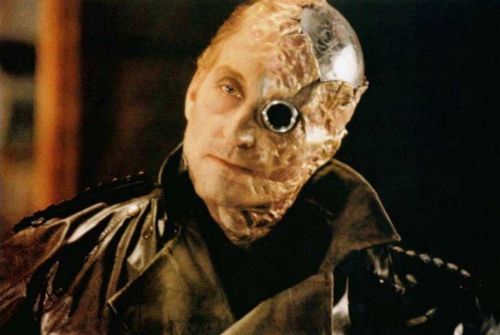
Mostly bright and cheerful, Space Truckers delivers a dose of lively humour with plenty of witty satire in a fast-moving storyline. A vengeful space pirate Macanudo (Charles Dance) is a cyborg menace, especially to sexy Cindy, in one of the movie’s rom-com sequences. However, the primary threat here is a shipment of rogue robots, war machines designed to destroy any military force, essentially re-programmed for the invasion and conquest of Earth. 


Coming from Stuart Gordon, the director of celebrated horrors Re-Animator (1985), and Lovecraftian classic From Beyond (1986), this space movie might have seemed like an unusual choice, but Gordon had previously also made cult sci-fi romp Robot Jox (1989), and the internationally successful Fortress (1992), and to Space Truckers he brings an expert understanding of subgenre concerns for a modestly budgeted production, knowing just how to honour and subvert fandom expectations and re-work clichés into something far more entertaining than typical genre fare.


In addition to Alien, this picture also pays obvious tributes to Kubrick’s 2001: A Space Odyssey and Roger Vadim’s pulp-inspired Barbarella. It hardly matters that, viewed here in glorious hi-def, we can see harness wires during some of the ‘flying’ in zero-gravity stunts. Most of the big special effects sequences are still pretty good though, and contribute so much fun to a highly amusing adventure giving the heroes a happy ending, one that’s blatantly corny and yet remains a satisfying conclusion.


Disc extras: new interviews with Stuart Gordon, composer Colin Towns, and art director Simon Lamont.

Friday, 4 May 2018

Killjoys: Season Three

Cast: Hannah John-Kamen, Aaron Ashmore, and Luke MacFarlane

Creator: Michelle Lovretta

430 minutes (15) 2017
Universal Playback
Blu-ray region free

Rating: 8/10
Review by Steven Hampton

Recent space opera movies have sometimes been disappointing. The Star Wars sequels proved to be merely watchable rehashes of jedi-isms and spectacular battles. Star Trek was an ultimately ruinous restarter for the venerable franchise, mired in super-heroics, dismal comedy (Simon Pegg is particularly awful as Scotty, an insult to the memory of James Doohan), and overdone lens flare. Although Metal Hurlant failed as sci-fi/ fantasy anthology, TV shows are generally still doing a better job of space opera narratives than big-scale movies.

Exploring the colonial industrialisation of the Solar system, The Expanse concerns miners working in the asteroid belt and the machinations of home planet Earth, and impressively stylish visual effects are matched by fascinating character arcs and highly intriguing plot-lines. Dark Matter is a more playful adventure about a team of mercenaries and the show blends post-cyberpunk techno-chiller tropes with interstellar action pitched on a subgenre scale between Star Trek’s politics and Star Wars’ conflicts.


Dark Matter’s genre counterpart Killjoys is a noir-punk about bounty hunters. Both shows benefit from strong female leads. The rogue heroes-versus-overlords influence of Blake’s 7 is apparent, but general pulp sci-fi themes are a greater influence than any specific TV series. Killjoys: Season Three pirates and then serves pop-culture puns from fantastic media and it’s cooler than kitsch, scripted by genre savvy writers cloning cyberpunk DNA and rebooting spacer western clichés, and turning out sharply witty dialogue as if they’re visiting our time-zone from the day after tomorrow.

“What if the monsters look just like you?”

This greatly entertaining Canadian production offers slickly fetishistic techno-futurism on industrialised alien planets, and Killjoys often belies its TV budget (with visual effects by Rocket Science) and so it looks far better than most indie sci-fi movies that are obviously trying too hard. With episode titles like ‘A Skinner, Darkley’, ‘The Lion, The Witch, & The Warlord’, ‘Necropolis Now’, and ‘Wargasm’, this series presents three likeable heroes for dangerous ops in Quad space, where fun-loving bounty-hunter Dutch (played by Hannah John-Kamen, who also portrays Dutch’s enemy Aneela, and is soon to be seen as ‘Ghost’ in Ant-Man And The Wasp), boldly goes where angels fear to fly, and doesn’t “have time to be careful”. 


Dutch is a team-leader for RAC agents D’avin (Luke Macfarlane), and his techie brother Johnny (Aaron Ashmore, Warehouse 13). They serve legal warrants (“the warrant is all”), break heads and often forget about taking down names. As the ship’s voice named ‘Lucy’ Tamsen McDonough is perhaps the most sarcastic computer character since Marvin, the paranoid android. Bionic performance-artist Viktoria Modesta makes a unique opponent as hack-mod villainess Niko. The heroes’ newly recruited nerd girl, socially awkward Zeph (Kelly McCormack), breaks free of typical comedy-relief role-playing and a typically sulky demeanour. 


War against parasitic aliens, the hive-mind sociopathic Hullen, looms over fate’s horizon and Dutch needs to assemble a militia army, but finds that enemy forces are brutal, and the morality of heroes (“the war is all”) is tested far beyond humane limits, while facing deadly betrayals and physical traumas. The season’s finale features the enemy’s armada arriving in planetary orbit just as the heroes prepare for battle in a kill-zone where Quad space simply isn’t big enough for both Dutch and her look-alike Aneela. Of course, there’s also a twist from the green-dream of memory. Killjoys is amusing, exciting, imaginatively detailed sci-fi action that shows the expensive cinema productions how it should be done. Binge-watch it. You know you want to.

Wednesday, 2 May 2018

The Mad Death

Cast: Richard Heffer, Barbara Kellerman, and Ed Bishop  

Director: Robert Young

180 minutes (12) 1983
Simply Media DVD Region 2
[Released 7th May]

Rating: 9/10
Review by J.C. Hartley

A long, long, time ago in front of a television set faraway, I saw a film in which one of the characters contracted rabies. He was held fast by a couple of guys while a third, possibly the hero, performed some tests. This involved bashing two bits of metal together to make a loud noise, while the poor unfortunate howled in pain. Then the hero poured out a jug of water in front of the man’s face and he behaved as if terrified. I was watching the film with my elder sister and she must have known about hydrophobia because I can remember her explaining this to me. After a little bit of googling and I’ve decided the film must have been Rage (1966), starring Glenn Ford, and, given the rules for the release of films for TV broadcast in those days, I must have seen it around 1970. Apparently, you can survive rabies if inoculated within six days, although the virus is generally considered 100% fatal, so Ford’s character might have survived. I had most of my early education from movies in those days.

I was always a dog lover up until I started working for Royal Mail. I was bitten by a dog at the end of my first week delivering solo. Even that experience didn’t put me off, that took another year or so. My all-time worst experience was on a housing estate, being harried by a pack of dogs some of which were no bigger than the average carpet slipper.  I crossed the road to where the dog warden sat in his van, to ask if he wanted to get involved. “There’s nowt we can do lad,” he said. The following week on another housing estate I was stalked every day by a huge Boxer dog, the sound of claws on a pavement is particularly unnerving to postmen. These dogs were obviously just let out for the day to roam around. Finally, I was cornered by two Alsatian puppies, puppies but well-grown.  By this time, I had completely lost my nerve. I yelled at them to “Fuck off!” and happily they did, thereby triggering the instant re-growth of my cojones, and I was never scared of dogs again. This story is designed to show why I could watch the slaughter of canines in The Mad Death with equanimity. I always felt that postmen should be issued with handguns, but they don’t call it going postal for nothing.

The Mad Death was filmed by BBC Scotland in 1981, and broadcast in 1983, did the renewed talk about the Channel Tunnel make it topical? The opening credit sequence with soupy visuals, a child-like voice intoning ‘All things bright and beautiful’, and wavery images of foxes, reminded me of the opening of the BBC’s later excellent adaptation of John Masefield’s The Box Of Delights in 1984.

 
Michu, a Siamese cat, is attacked by a fox in France. The female owner smuggles her cat into Britain. At a party, the cat has a fight with the householder’s Collie, scratching it on the nose, before running off where it is run over by an arriving guest’s car. A fox then consumes the road-kill, and so it begins. There’s a nice circular narrative to this short, three-episode series, the opening scenes are a little bit confusing, introducing characters seemingly at random, but things soon settle down. A middle-aged woman, Miss Stonecroft (Brenda Bruce), lets her dogs out of her van to run about on a shore. A young girl teases one of the dogs with a stick and receives a nip for her pains, but fortunately Dr Ann Maitland (Barbara Kellerman) is on hand to administer first-aid. It becomes clear that she knows the child’s father, Michael Hilliard (Richard Heffer), whether they have arranged to meet here is unclear. Both parties have partners, although Hilliard is obviously estranged from his daughters’ mother, and it becomes clear that they have at some point had a relationship with each other. Hilliard, a leading veterinary officer presumably with the Ministry of Agriculture, is due to take up a post with the UN Food and Agriculture Organisation in Brussels, however coming events will see that this appointment will be delayed.

Businessman Tom Siegler is juggling a wife, a mistress, and another possible girlfriend in the person of his secretary. Stopping his car to make a call from a rural phone-box he discovers a fox, quite placid and seemingly tame, he puts it in his car and takes it home to his wife. Siegler is played by the late great Ed Bishop, one of British television’s busy go-to American actors, whom I first encountered as Commander Straker in Gerry Anderson’s UFO (1970-3), although he had minor roles in a couple of Bond movies, and as the lunar shuttle pilot in Kubrick’s 2001: A Space Odyssey (1968).


Siegler cuts his finger slicing a lemon for gin and tonics for himself and his wife, then infects the wound when petting the fox. The following morning, the rabid fox is in a state of rage and Siegler is forced to scare it away by driving his car at it. He visits his mistress Jane (Debbi Blythe) and bites her lip when kissing her. The following day he is unwell, and after crashing his car and suffering a concussion he is admitted to hospital. Experiencing frightening hallucinations involving drowning and erotic imagery he is kept in for observation. When his condition deteriorates, a West Indian nurse with experience of rabies recognises the symptoms. Dr Maitland is called in, but Siegler dies.

Hilliard is presented as a typical maverick with little time for authority. The government want him to take a lead role coordinating the response to the rabies outbreak as he has prior experience from working abroad. He initially refuses as he is eager to take up his new post, but the Minister Bill Stanton (Jimmy Logan) uses emotional blackmail to persuade him to stay, a second victim after Siegler is a young girl the same age as one of Hilliard’s daughters. The story then unfolds with the procedures brought in to control the outbreak, and some of the reactions from the animal-loving British public, as their domestic pets are forced to wear leashes and muzzles or are impounded and quarantined. Hilliard is provided with a press officer to oversee public relations, and he reads Hilliard the hate-mail that the vet is receiving. The press officer, Bob Nichol, is played by Paul Brooke, who memorably shed tears over Jabba the Hut’s Rancor beast after it was despatched by Luke Skywalker in The Return Of The Jedi (1983). Hilliard and Ann resume their affair fuelling the suspicions of Ann’s partner, the aristocratic Johnny Dalry (Richard Morant). Ann is ready to leave Dalry but she is reconciled with him when Hilliard orders a horse that Dalry has bought for her to be shot rather than quarantined.


It is discovered that reclusive Miss Stonecroft, reappearing after her early scene, collects stray dogs and provides a home for cats in her castle. As the place is inadequately secure the dogs are taken into quarantine. Miss Stonecroft subsequently visits the pound with a set of bolt-cutters and releases some 60 dogs, some of them infected with the virus, into the wild. This is the cue for a major operation involving the army, and police sharp-shooters, who scour the area of countryside where the pack of dogs have fled. Dr Maitland visits Miss Stonecroft but the disturbed woman traps her and imprisons her in a room with her ‘naughty’ cats, despite Ann suffering from ailurophobia.

Meanwhile, Hilliard, hunting for some dogs which have slipped through the army and police cordon, finds himself stalked by Dalry, as Ann has not returned home. Dalry assumed she was with Halliard, but the pair realise she must be at Miss Stonecroft’s castle. When Miss Stonecroft releases her rabid cat into the room where she has imprisoned Ann, the Doctor manages to capture the cat in her jacket, and when Miss Stonecroft opens the door to investigate the noise, Ann hurls the cat at her, whereupon it claws her face. Ann flees and is reunited with Halliard and Dalry. They enter the castle where Miss Stonecroft attempts to shield one of her rabid dogs which has returned home.  The dog leaps at his mistress, and she falls from a landing and is killed, Hilliard shoots the dog.


Stanton sees Hilliard off at the airport to take up his new post. Stanton is glad that the crisis is over but Hilliard warns him that the incubation period of the virus means that there could be more cases. The woman whose actions precipitated the outbreak is seen preparing to return to France, being reassured by her male friend that her cat Michu might still turn up. Outside, Hilliard sees two children teasing a collie dog which is leaning out of the window of a parked car, the dog is snarling, it has a scratch down the side of its nose.

It’s interesting that these old TV series are being released. This one has hardly aged apart from some of the extraordinary outfits sported by Barbara Kellerman. It’s worth noting that, as with Doomwatch (1970-2), the central female character is portrayed as a strong and independent professional, and not just as eye-candy or a ‘screamer’. Kellerman was Clare Kapp in Quatermass (1979), and a memorable White Witch in BBC’s The Lion, The Witch, And The Wardrobe (1988). This series obviously had a decent budget, there is a lot of location filming and the third episode featuring a literal army of extras and a helicopter must have cost a bit. Apart from a slight descent into melodrama at the end, with Miss Stonecroft reaping the retribution of her actions, the drama remains taut and gripping throughout. Would the great British public react so illogically now in the face of advice from ‘so-called experts’, plus ça change, plus c’est la même chose.


Friday, 27 April 2018

Nightmares

Cast: Emilio Estevez, Lance Henriksen, and Veronica Cartwright   

Director: Joseph Sargent

99 minutes (15) 1983
101 Films 
Blu-ray region B
[Released 7th May]

Rating: 7/10
Review by Steven Hampton

One of the best sci-fi horror anthology movies just got better with its very welcome hi-def release on dual-format Blu-ray and DVD. Written by Christopher Crowe and Jeffrey Bloom, Nightmares has four chapters directed by Joseph Sargent (1925 - 2014), in a picture of variations on ‘devilish’ monster stories.

Late-night shopping, when all the local petrol stations are closed, plunges Lisa (Cristina Raines, The Sentinel) into ‘Terror In Topanga’, where an escaped maniac has already killed an L.A. sheriff. Thankfully, the endangered housewife meets an unexpected hero (William Sanderson, Blade Runner), and at least the survivor appears willing to give up smoking. This is the slightest story and the weakest segment of the movie but its quality of production values elevates a typical woman-in-peril crisis and so gets this genre movie off to a fairly promising start.


‘The Bishop Of Battle’ concerns the fate of arcade hustler J.J. (Emilio Estevez, just before his starring role in cult-classic Repo Man), who beats every video-game champ and then splits. That’s until he plays BOB to level 13 and becomes part of a still-amusing showcase for computer animation effects, combined with a technological plot-twist that pre-dates a similar development in space adventure movie The Last Starfighter, while also hinting at the commonplace virtual reality motifs of cyberpunk first established by Tron (1982), and later reformulated in The Matrix trilogy.      


Lance Henriksen appears in ‘The Benediction’ as Frank, a faithless priest haunted by dark signs in dreams, and demonstrating the intensity that won him later acclaim in Near Dark and Pumpkinhead. On desert roads, our hero confronts a malevolent vehicle that owes a genre debt to The Car (1977), a movie that followed Spielberg’s Duel (1971). Here, the more blatant symbolism offers both a devil metaphor and a character-study that delivers a morality play about the question of evil in the world.


As housewife Claire, Veronica Cartwright (Alien) is terrorised by a monstrous invader in ‘Night Of The Rat’. The sewer pest provokes scenes of domestic horror that effectively dramatises the family problems of a failing American marriage. A confrontational finale pays tribute to The Exorcist (1973), and Poltergeist (1981), and the gigantic rodent is a modern mythical contrast to more realistic creature-feature shocks found in cult movie Of Unknown Origin (1983).


Unlike the more famous Twilight Zone: The Movie (also released in 1983, and prompting a quite excellent revival of the celebrated TV series), and the same decade’s Creepshow, written by Stephen King, Nightmares did not result in any sequels, but it’s a far superior anthology-movie to Creepshow 2 (1987). The core appeal of Nightmares today lies in its neatly imagiative use of mixed-genre tropes and its early showcase roles for Estevez and Henriksen.        

Disc extras include an interview with main writer Crowe, and an option to play the movie in full-screen mode (but, honestly, is that cropped aspect ratio likely to appeal to anyone nowadays?).

Saturday, 21 April 2018

The Earth Dies Screaming

Cast: Willard Parker, Dennis Price, Virginia Field, Thorley Walters, and Vanda Godsell

director: Terence Fisher

62 minutes (PG) 1964
20th Century Fox 
DVD Region 2

Rating: 7/10
Review by Richard Bowden

After a series of unexplained disasters and deaths - planes and trains abruptly crashing, people collapsing for no reason, and so on - the English countryside is reduced to a few survivors. After the worst has passed, test pilot Jeff Nolan (Willard Parker) arrives at a seemingly deserted village...

The Earth Dies Screaming starts as something of a misnomer, in that budget limitations mean we only see the disaster’s main effects manifest in a very localised area of northern England. And as for the screaming, there’s no human sound heard at all until eight minutes into the story - that’s well over 10 percent of the running time. Like many of the small cycle of English invasion films made at this time - Unearthly Stranger (1963), The Night Caller (1964), Invasion (1966) - Fisher’s movie is small scale and un-ambitious for various reasons, almost domestic in its setting, frequently implying a catastrophe at a personal level just as much as a national one.

Such films are in contrast to those produced in America, which critics have typically interpreted in relation to the contemporary red scare and fear of communist take-over. In England, invasion threats by this time were often less grandiose and paranoid, relying more on alien intrusions into more realistic, even humdrum worlds, places where the ordinary is ever present. Like the cult movie Devil Girl From Mars (1954), substantial scenes of Fisher’s movie take place in the comforting atmosphere of a pub or nearby. 


In a disaster it seems, British folk naturally congregate round the local hostelry for comfort as well as safety - one thinks of the last refuge taken in Shaun Of The Dead. In Unearthly Stranger, the extra-terrestrial threat is discovered even more locally, being found within the relationship between husband and wife; events in Invasion principally take place at a local country hospital, and so on.

Director Terence Fisher is most known for the series of gothic horrors he helmed over at Hammer. Colourful, often erotically charged and gruesome, the Frankenstein and Dracula outings are what have occupied critical attention, then and now. Fisher’s SF work has been more readily dismissed; a genre apparently in which he had little interest. It began with Four Sided Triangle, and Spaceways (both 1953).

A decade later in his career, he made The Earth Dies Screaming, being the first of a trilogy for the appositely named Planet Productions company. The other two films were Night Of The Big Heat (1966), and Island Of Terror (1967). All three feature an alien invasion and a small group of people trying to fend off the intruders. Negative responses to this work perhaps stem from the fact that, often, it’s the people who are more interesting than the monsters and junk science on display and that the films lack the vibrancy of his horror work.


At the heart of The Earth Dies Screaming are three relationships: that between Quinn Taggart (a splendidly caddish Dennis Price), and Peggy (Virginia Field); the often drunk Otis (Thorley Walters), and his party friend Violet (Vanda Godsell), as well as the young couple Mel (David Spenser), with the pregnant Lorna (Anna Palk). Starting out independent of this group is Jeff Nolan, played by the film’s sole American actor.

Producer Robert Lippert had a successful formula of adding transatlantic appeal to his films by stocking them with token imported talent, and here Willard Parker fits the bill. Parker, who appeared, with little impact it must be said, in over 50 films during his career, plays Nolan, the man who takes charge of events, organises the survivors, and figures it out - right down to where the alien’s transmitter can be found.


In this regard he can be seen, in his mild way, as the ‘Quatermass’ figure of Fisher’s story: a technically competent individual who takes charge to protect British society from intrusion. While no pure scientist, Nolan still has enough know-how to quickly grasp what has happened, how the invasion can be thwarted and go on to take decisive action. In doing so, by the end of the film, he wins the right to a relationship of his own.

Critics such as Peter Hutchings, in his piece ‘We’re All Martians Now’ from British Science Fiction Cinema (Routledge, 1999), have identified such influential figures as typically being a “boffin-like protector of a society which seems incapable of protecting itself.” At the same time of course, through the novelty of his presence, Nolan is a reminder of British insularity. At the time many of these films appeared British society was still relatively isolated, but felt under pressure from new pressures and changes both international and local.


In The Earth Dies Screaming, only the cynical Taggart has a competing world-view that’s as strong as Nolan’s. For Taggart the new global conflict is over. Worse, “whoever did it has won... it’s every man for himself,” fatalistic sentiments in stark contrast to the famous spirit of the blitz, which would have been familiar to many of those watching. The punishment for his criminality and selfishness will be the loss of his tenuous relationship with Peggy and, ultimately his humanity, when he becomes part of the alien zombie army.

Most obviously, the big social change in Fisher’s film is obvious - a successful first strike against British society, together with silver-clad aliens walking the streets with their zombie work-force in support. Blank-eyed and as slow-moving as their masters, these zombies are among the most effective elements in the film. They must have been rather a novelty to contemporary audiences. I can’t, off-hand, think of an earlier representation of the creatures in British cinema before this (Hammer’s Plague Of The Zombies appeared two years later, but even that was set in the past). They provide one of the highlights of the film - a scene when Peggy is pursued, then trapped breathlessly in a bedroom closet, when Fisher makes use of a very dramatic close-up to add terror.


In contrast to the unsuccessful efforts of the un-dead to find a female, Nolan succeeds in gradually establishing a relationship and, one presumes, goes on to a successful romance. His success against the invader acts as a catalyst and, by the end of the film, he is entitled to re-integrate back in society. There’s a parallel to be found between the zombie’s painfully slow pursuit/ search and unnerving, soulless staring at the closet in which Peggy hides to a scene where Nolan had looked on, affectionately, as she pottered over small things in the pub’s kitchen. The difference between humanity and the alien, the film suggests, is that the former can bring value and sentiment to what it sees and so, once again, the British invasion variant gravitates naturally to the domestic.

The Earth Dies Screaming is further helped by a very effective score by Elizabeth Lutyens, as well as some high contrast, atmospheric cinematography by Arthur Lavis, especially effective when shooting on village location. These are elements that help to make it my favourite out of Fisher’s small group of SF movies, a feeling which even the overacting of Walters (who also popped up by way of support in some of the Hammer horrors) can’t dissipate. It is also blessed with a dramatic pre-title sequence - a world wrecked by sudden accident, recalling the night before Day Of The Triffids, as well as an eerie sense of a familiar landscape made empty, a horror-fantasy tradition which persists right down to such British films as 28 Days Later. Fisher’s film may be short, cheap, and with a disappointingly flat denouement, but its modest pleasures easily invade the mind.


Monday, 16 April 2018

Accident Man

Cast: Scott Adkins, Ray Stevenson, Michael Jai White, Ray Park, and Amy Johnston

Director: Jesse V. Johnson

101 minutes (15) 2018
Sony DVD Region 2

Rating: 7/10
Review by Ian Shutter

A lively comedy-thriller based upon a memorably absurdist comic-strip, written by Pat Mills and Tony Skinner, and published in colour weekly Toxic! (1991), Accident Man is, basically, a story of vengeance, as up-market hit-man Mike Fallon strives to discover who murdered his ex-girlfriend. His rampage through disreputable venues of the big city’s underworld stirs up his varied league-of-assassins type colleagues, and results in trial-by-combat confrontations with known associates in a friendless society.


Unlike the recent American hit-man movie John Wick, where professional killers congregate in a posh hotel, this British production has rather coarse, often misogynistic, characters, and grim, splattery killings that are organised by a pub landlord. In contrast to slick Hollywood efforts, and even other British action movies about assassins like The Tournament (2009), this is a lower-budget London-centred sub-genre project concerning wholly gritty and bleak unreality where British cultural stereotypes, such as Big Ray, the pub landlord (a fiercely moustachioed Ray Stevenson, once the star of sequel Punisher: War Zone, before his casting as Asgardian warrior Volstagg in Thor movies) are remade as larger-than-life, with routinely disconcerting and equally amusing conviction.


Fallon’s climactic fight against Jane the Ripper (top stunt-performer-turned-actress Amy Johnston, Female Fight Club) cranks up the movie’s engine to run on a pure comic-book adrenaline. It’s a fine closing act. Director Jesse V. Johnson comes from a background in stunts and it shows, most obviously, in the slickly stylised choreography for this movie’s fighting scenes, where every punch and kick is expertly shot despite the modest budget. What's unexpected here is how precisely the humour works to make the comicbook world come to life. This is not a particularly realistic milieu but more of a tribute picture to the ever-popular cinematic realm of contract killers.


However, Accident Man draws its action genre riffs not from the likes of Michael Winner’s classic The Mechanic (1972), a notable vehicle for stony-faced Charles Bronson, but from Simon West’s remake The Mechanic (2011), starring Jason Statham. The main difference for Accident Man is that antihero Fallon pursues an investigation and revenge plot instead of being a retiring mentor (Bronson’s melancholic Arthur Bishop), who is ultimately betrayed by his protégé. It borrows far more from the Statham version of Bishop, and that’s arguably a very good and wise choice.


Saturday, 14 April 2018

Score: A Film Music Documentary

Featuring: Hans Zimmer, Danny Elfman, John Williams, James Cameron, and Quincy Jones

Director: Matt Schrader  

92 minutes (E) 2016
Dogwoof DVD Region 2

Rating: 8/10
Review by Howard Yarborough  

Essay movies have a long pedigree in the cinematic documentary field with a special reference to critical academic works. Music for the screen is of such intrinsic value to visual entertainment its importance cannot be stressed enough. Score: A Film Music Documentary ranges from the bygone times of Wurlitzer theatre organs played for silent movies, to synthesisers a go-go, and it explores how music for the movies is created by bold experimenters and canny interpreters, not just by successful musicologists. Sometimes they are vague historians of musical instruments - including pipes, drums, and strings - from a variety of cultures, and many astute composers of classic scores fuse exotic folk sounds with cutting-edge technology, and time-distorting innovations, to generate the strongest and most evocative memories that might well be possible without factoring in the direct sensorial effect on the human brain of smells.


As this documentary attests, movie scores communicate both raw and refined emotions capable of inducing uplifting tears of joy like few other experiences, and cinematic music frequently provides the engine-heart of a whole production with changes of tone supporting an unfolding narrative. It’s quite interesting how many top composers often appear to be swaggeringly odd eccentrics, with even a few hipsters, or staidly professorial types. Perhaps their anti-fashion sensibilities are just another expression of a magically imaginative approach to breaking traditional rules, subverting directorial expectations, and absorbing various contemporary rock and pop influences for an essentially visual medium.


Rachel Portman and Deborah Lurie are not the only women interviewed but they are the only two female composers among nearly four dozen such interviewees in this evidently male-dominated field, despite a far greater diversity usually found in orchestras or bands of session players employed for scoring movies. How much of this bias might be due to the familiar tyrannical stereotype image of the orchestra conductor is left sadly unexamined and unquestioned here. Dr Siu-Lan Tan is a professor of psychology who studies and teaches how music works on the brain. Her fascinating comments are key scenes in this educational movie’s highlights of investigating the ways that sublime dissonance from aural products of creativity affects or challenges us while we are watching movies.


The compositional ambitions that can result in a ‘beautiful chaos’ are faced by not only sometimes ‘insane’ levels of only unconventional complexity, but enormous pressures from studio executives. Authentic milestones celebrated here include the screechy violin of Hitchcock’s Psycho, the famous five-note motif that made Close Encounters Of The Third Kind - a sci-fi classic that’s partly about music used for communication with aliens, and the unexpected revival of rousing orchestral themes for Star Wars. Whether entirely complimentary or radically counter-intuitive of acoustic-space overtures, dramatic cues, and simple codas that raise goose-bumps, all of these provocative moments, electrifying statements, and sequences of dark melancholy can sound timeless and inspirational. Movie music is clearly a unique art-form that bridges two centuries and, more importantly, reveals and revels in an astonishing power to move minds that defies rational scientific explanation.


Pick of the disc’s extras: James Cameron interview (29 minutes), which is partly a remembrance of James Horner.