Sunday, 13 June 2021

Parallel

Cast: Aml Ameen, Martin Wallstrom, and Georgia King 

Director: Isaac Ezban 

100 minutes (15) 2018

101 Films DVD    

Rating: 7/10

Review by Steven Hampton

Reminiscent of Shane Carruth’s Primer (2004), this Canadian thriller has young techies discover a secret room with a kind of magic mirror that’s a dimensional portal to a multi-verse of possibilities and career opportunities. The kids develop their unfair advantage by exploiting differing clock-speeds in some mirror-world timelines. From stolen inventions to copied artwork, creative industries are a potential goldmine, but is theft from alternate worlds just a victimless crime? The childish indulgence of blowing up $1 million sounds like fun, until creepy doppelganger antics result in sudden death.


Like a next-gen version of TV show Sliders (1995 - 2000), Mexican director Isaac Ezban’s Parallel is perhaps the best wonderfully witty sci-fi movie since Looper (2012). It brings out dark paranoia in the protagonists that ramps higher with every new level of deception folded sideways into their original reality. Somewhat unavoidably, determination soon becomes obsession when emerging characters develop complicated ambitions into money-spinning solutions to problems and needs that didn’t exist before. It cleverly fulfils a precept of all the best SF about extrapolation of any fantastic idea to its logical conclusion. Intelligent sci-fi does not have to be a confusingly intellectual puzzle. Parallel is instantly engaging, like a heist-movie with a moral dilemma, and it succeeds at being hugely entertaining without ever losing its appeal to fans of Twilight Zone-style mysteries.


“I know that sounds crazy, but you have to believe me.” Oh yes - it’s just not possible to avoid such dialogue in a movie that makes unreasonable demands on the viewer’s sense of ironic humour. Made in 2018, Parallel might have been overlooked for an international release until now because it lacks any Hollywood star names, although Kathleen Quinlan appears briefly, in a prologue sequence. It could be this year’s re-watchable Tenet on DVD. Look out for the strange mirror’s final and weirdly fatal tilt. It’s gruesomely slippery when wet.

Monday, 24 May 2021

Zack Snyder’s Justice League

Cast: Henry Cavill, Ben Affleck, and Gal Gadot 

Director: Zack Snyder 

242 minutes (15) 2021

Warner Bros. 4K Ultra HD 

Rating: 10/10

Review by Christopher Geary

Contrary to a well-known and often-quoted designer aesthetic, less is not more. More is actually often much better (unless you’re a weight-watcher on a crash-diet). Quality not quantity, is another highly relevant saying that might help form a thoughtful judgement of something’s value, but twice as much is assuredly going against a minimalist creative ethos. There is no escaping from a confrontational approach to any comparison between this version, the definitive edition of Snyder’s unfinished or abandoned picture, and the earlier movie ‘completed’ (supposedly) by Joss Whedon as contracted writer-director for hire. Whedon’s mercenary work on the essentially disappointing two-hour film Justice League (2017) could now be seen as Hollywood’s longest-ever trailer, a rather simplistic prelude for this magnificent new classic of superheroic movies. The most clear precedent for this kind of re-building a previously finished and released movie is (also from Warner Bros), Superman II: The Richard Donner Cut (2006). Credited to Donner’s replacement, Richard Lester, Superman II was released in 1980, and its original director’s cut remained a fandom daydream, until the makers of Bryan Singer’s tribute movie Superman Returns found unused footage by Donner in the studio archives. Well, at least, for Justice League, we didn’t have to wait so long this time.

Zack Snyder’s Justice League picks up plot-threads from the climactic sequence of Batman v Superman: Dawn Of Justice (2016), when the dying Superman’s yell echoes round the globe. Much more than another modestly enhanced, or just expanded edition (as seen in versions of Singer’s X-Men movies), this four-hour director’s cut unfolds into an expansive epic that almost outgrows the whole superheroes genre, never mind the DC films’ canon. Wrapped in the media’s cultural peak of science fiction, this supreme example of modern American mythology fields an unholy Unity of three mothers (in magical boxes), bringing apocalypse from the stars. Only the second coming of a space messiah, as crisis prompts resurrection, renews 21st century hope for the Age of Heroes. The big story-arc that Marvel accomplished for the Avengers in five adventures (including Captain America: Civil War), DC has now done with the Justice League in just two movies. 

This ‘Snyder cut’ includes clever segues, linking different scenes, as melancholy becomes a thing of universal experience, before a progressive resurgence of trust spins a society’s grief into a state where six meta-human outsiders might become civilisation’s defenders. ZSJL delivers on the promise of Man Of Steel and BVS by giving fans a greatly improved, captivating drama with vastly sophisticated sci-fi action chaptered for up-market appeal. More than another great super-team origin, the movie ushers genre showmanship into an emotionally resonant exercise of group dynamics and story-telling excellence. It’s broadly independent of pop-cult references, and other typically mediocre concerns, like Whedon’s colourful lighting set-ups, blatantly fetishistic sexism, and hyper-masculine fights, lacking a genuine style or poetic grace. Whedonisms of light-hearted and frivolous wit, dialogues often based on quips, and in-jokes, are weeded out, happily replaced with fresh lines that fully respect all characterisations with an in-depth veracity, instead of casually poking fun at DC’s premier line-up of thoroughly modernised heroes. It must be noted, though, that butler Alfred’s (entirely welcome) sarcasm, always at the expense of Bruce Wayne’s ego, is assuredly more prevalent, and effectively deflating, here. 

Although lots of scenes remain the same, significant editing, during the movie’s renewed post-production phase, means that even already familiar elements are freshly presented with gritty vigour and surprisingly richer ambition. The primary villain Steppenwolf is very much a case in point. Previously, the role relied on an actor’s distinctive voice to provide the obvious animations with a suitably life-like presence, but here this alien character’s portrayal depends far more on superior visual effects, including a constantly twitching ‘active’-armour suit. Many pivotal sequences are revised from Whedon’s frequently-contrived effort, and this work eliminates any superficial and irrational twists, to embrace convincing subtlety in characterisations, with responses to tragedy that embody objectives more positive than any form of vengeance. 

Now suitably frightening, death-cult terrorists in the Old Bailey are a grim foreshadowing of alien menace. Scenes that looked quite random choices in the earlier ‘Josstice League’ are now fully matured, and alive with a purpose, seemingly logical, or perhaps inevitable considering all the forces at work, connecting events, agendas, or often fateful decisions. The meeting of Barry Allen (alias, the Flash), and Iris West, during a car crash in a slow-motion sequence is elevated for wonderful visual poetry here by romantic ballad Song To The Siren, a well-chosen cover-version by British singer Rose Betts. If it’s remembered in years to come, for nothing else, ZSJL deserves critical attention for breathing astonishing new artistry into the cinematic cliché of love at first sight. A brief, yet sublime, encounter it’s one of those very rare but iconic combinations of images and music with spellbinding affect - a bewitching 'pop-video' experience that’s almost certain to link this movie to that song, forever.       

Spectacular effects and exceptional super-stunts accumulate into dazzling thrills. A vastly improved colour palette is only one of the upgrades deployed here with careful reverence for world-building elements and the back-story developments of varied characters. Of course, ZSJL also benefits from the hindsight of knowing what worked, flawlessly, or better than usual, in Avengers movies, Infinity War and Endgame, and so wounds are bloody here, and decapitation is a final solution. Despite his robotic appearance, the troubled hero Cyborg, short-changed as a newly-minted character by the 2017 version, is revealed as being far closer in aptitude or philosophy to Marvel’s android the Vision, so he’s not DC’s answer to hip genius Iron Man.

In several important moments, Darkseid appears as a monstrous being rather ghastly in aspect, and ultimately more menacing than overly-talkative Thanos in Avengers movies. Instead of being over too quickly, now the united League’s final battle is an extraordinary feat of cosmic justice. Its impact on the DC universe feels profound and looks awesome. The worthwhile multi-part epilogue offers plenty of scope for another sequel, although at time of writing, it seems unlikely. Perhaps if this movie proves hugely successful enough, the producers will think again. Like a 'Change Machine' in human form, Zack Snyder acquits his grandiose ambitions with tremendous ability. This UHD edition spans two discs with a four-chapter block (totalling 142 minutes), and two closing chapters on a second disc (adding 100 minutes). Disc one includes featurette extra: Road To Justice League (24 minutes).

Monday, 10 May 2021

A Glitch In The Matrix

Director: Rodney Ascher 

108 minutes (15) 2021

Dogwoof Blu-ray

Rating: 6/10

Review by Steven Hampton

One of the greatest philosophical questions that emerged from science fiction’s concerns and considerations about Virtual Reality is, basically: if nothing’s physically real in cyber-space, must we then simply abandon all morality? Where’s the harm in ‘torture’, slavery, and/ or ‘murder’ by termination if there’s no actual victim affected by apparent ‘crimes’? As if this crucial genre riddle wasn’t disturbing enough what if ‘nothing’ we know is ‘real’?

Is our Earthly reality just a simulation running on cosmic machinery of a super-advanced computer system? Kardashev’s theory of mega-civilisation types might suggest how it all could work. If there’s no practical difference between type IV (universe-spanning) and/ or type V (Ω) multi-verse scale civilisations, and our various notions of god, then (probably?) we cannot know for certain, anyway. This brain-smasher wraps itself in enigma and mystery. 

Seen here in archive clips, author Philip K. Dick’s popularisation of genre theories about a potential multi-verse of parallel worlds form a cornerstone of argument that’s rarely been questioned, although one seemingly-baffled man’s emergence from a (reportedly health-related) personal crisis with claims of cosmological visions now looks, in a cynical century decades later, like a headline-grabbing publicity-stunt. Neurotic reactions to intense déjà vu, and fervently grandiose delusions of devout faith, in organised or cult religions, ropes in other extreme possibilities, yet some of the commentators interviewed for this movie’s array of viewpoints appear to confuse possibility with probability. 

Although several Twilight Zone (1959-64 ’85-89/ 2002-3/ ’19-20) motifs are hardly even judged as relevant here, Wizard Of Oz (1939) is cited by a clip, while versions of Alice In Wonderland and Lewis’ Narnia books should have got a mention just for adding their own similarly hallucinatory contrivances, and blending blatant fantasy themes into genre lore. Reading such fairy tales while growing up is still a mind-expanding route to appreciations of adults’ genre literature, if not always lessons in worthy moralities and ethical thinking. A notable jumping-on point for V.R. in SF was Daniel Galouye’s 1963 novel Simulacron-3, adapted for German TV as Fassbinder’s World On A Wire (1977), and then filmed as The Thirteenth Floor (1999) by Josef Rusnak. The original Star Trek episode The Cage (1965) can nowadays be easily re-interpreted as a prison in dream-space, while McGoohan’s cult TV series The Prisoner (1967) - especially its ‘western’ styled episode Living In Harmony, offered a proto-VR, that led SF development in Crichton’s theme-park Westworld (1973), and Sasdy’s Welcome To Blood City (1977).


While Disney’s visual futurism in TRON (1982) opened the hidden curtains of cyberspace, Cronenberg’s Videodrome (1982), and his later eXistenZ (1999), exposed the new-fleshy layers of trickery. Trumbull’s Brainstorm (1983) demoed recordings of ecstasy and death, Verhoeven’s surreal spy-fi Total Recall (1990) plugged us into a pseudo-holiday machine. Later, forming a tidal-wave of duplicity or derangement, Bigelow’s millennial actioner Strange Days (1995), Leonard’s unboxed Virtuosity (1995), and Proyas’ nightmare-movie Dark City (1998), explored increasingly dystopian trends, while Carpenter’s witty comedy They Live (1998), expanded from Ray Nelson’s story Eight O’Clock In The Morning (1963, matching Galouye’s book - and completing a 'cyclical' timeline). Media fun, at the expense of ideas, took centre-stage for Weir’s The Truman Show (1998), before the Wachowskis’ The Matrix trilogy (1999-2003) re-articulated most of the SF texts and media that we’d got, so far, into an endlessly-debatable idealistic thriller of humanity unknowingly enslaved by A.I. 

When 21st century technology rarely does what it’s actually made to do (and never mind whatever users wish it could do), it’s simply no wonder that a century of SF cinema, plus a lifetime of genre TV shows, and the complexities of game-player media now undermine human (already limited) perceptions of reality. Sometimes when the unreliability of memory, anti-social boredom (factor in the side-effects of drink and drugs), results in a conspiracy theory of global scale (faked missions to the Moon, climate-change denial?), can so easily prompt depressive paranoia, and nihilistic responses, with down-spiral thinking only good for circling the Libertarian drains of social order. (See how easy it is to slip into a ranting mode?) The fascinating subgenre continued in very different ways like Spielberg’s Ready Player One (2018), Finnegan’s horrific Vivarium (2019), and in TV remakes such as Westworld (since 2016).


A Glitch In The Matrix fields various escapist fantasies of isolated obsessive nerds, and social-maverick outsiders’ undiagnosed mental problems, as if assorted video-phoned-in contributions, about whimsical “OMG-U-guys” maybes, by sundry weirdoes, should really count for... well, something. Undeniably, there’s an entrancing alienation theme set free to run wild here, but as too many discordant or self-regarding, or masked for anonymity, voices pile-on with repetitions of rants as story-telling, a lot of this flashy documentary’s raving-mad narrative coherence evaporates, quite ironically. Anecdotes are presented as evidence with no scientific rationale, and so tall tales and ripping yarns lack any shreds of credibility. 

Peculiarities accumulate, alongside theoretical musings that date back to Plato, instead of studying the undoubted impacts on our consciousness of all these SF ideas from books or media (there are too many exemplars to list here), quite likely to have surprised readers, and stunned watchers, with phildickian concepts they’d never imagined. As previously, in Ascher’s feature-length debut Room 237 (2012), a critical assessment of Kubrick’s iconic horror The Shining (1980), the director’s approach is wholly inconsistent with any typical non-fiction. Digressions and diversions are strewn throughout, and so fairly logical trains of thought often derail into an unfortunate incomprehensibility. Still, this crazy ride to an entirely unreachable destination is worth its sensory-ticket for some remarkably abstract scenery.

Friday, 7 May 2021

Daughter Of The Wolf

Cast: Gina Carano, Brendan Fehr, and Richard Dreyfuss

Director: David Hackl

84 minutes (15) 2019

Dazzler DVD

Rating: 6/10

Review by Donald Morefield 

Something like “I’ve come for my boy” has become a clichéd line from revenge-westerns, but for this crime thriller of a kidnapping plot, its family-rescue drama turns into a brutal manhunt, as Daughter Of The Wolf concerns several gritty confrontations, between the mother and the kidnappers of her son, where basic humanity is eclipsed by animal rages. Vigilante heroine Clair (Gina Carano) meets the balaclava henchmen, to deliver a ransom payment, but this handover of cash is jinxed by their double-cross, so a car chase and an inevitable road crash are the result of a botched solution to the crisis.  


Stroppy teen son Charlie is rather more than simply a helpless pawn moving through this sinister game of one-upmanship. Not just another skinny blonde action star, former MMA champion Gina ‘Crush’ Carano successfully beats up bad-guys more convincingly than any of today’s athletes turned actresses. Her fighting opponents here include thug turned anti-hero Larsen (Brendan Fehr), and the rather more credibly dangerous Hobbs (Sydelle Noel). Primary antagonist Father (Hollywood superstar Richard Dreyfuss) delivers his brimstone rants with aplomb. 


Film-maker David Hackl is clearly no stranger to horror stories about humans or animals, since he made sequel Saw V (2008), in that popular genre franchise, and Into The Grizzly Maze (2015). This often spectacular movie skilfully conjures a malevolent atmosphere for location work on chilly mountainside terrain, especially in grisly scenes of typically poetic justice. These are cleverly structured to involve a pack of wolves in Clair’s hunting scenes and so frequent blood-in-the-snow images on widescreen landscapes punctuate this grim fairy-tale, shot with startling colour and motion, despite its general stillness in the frozen forests.

Although this picture never matches the dramatic intensities of Taylor Sheridan’s Wind River (2017), there are obviously lower-budget similarities here - as bitter and twisted, or bruised and battered, people explore human darkness in a world that’s mostly whiteness.

Sunday, 4 April 2021

Catch Us If You Can

Cast: Dave Clark, the Dave Clark Five, and Barbara Ferris

Director: John Boorman

91 minutes (12) 1965

Studio Canal Blu-ray  

Rating: 8/10

Review by J.C. Hartley

I reviewed this for the DVD release in 2009, and I still think it’s a great film. As I wrote back then, I first saw it as part of a ‘pop goes to the movies’ thing, that went out on a Tuesday night on BBC1, probably in the early 1970s, when films had a six-year embargo preventing early release for television while they might still be on the theatrical circuit.  My early teens were spent watching every 1960s movie that came up, a parallel education for a naive schoolboy, as that period saw cinema addressing the so-called ‘permissive society’, a period later blamed for all society’s ills by Mrs Thatcher, who denied the existence of ‘society’ in the same breath. 

Just discovered that Peter Nichols, who wrote the screenplay for Catch Us If You Can (aka: Having A Wild Weekend), died in 2019, aged 92; although the Guardian obituary seems to think this film was a documentary about the band. I also discovered that Nichols wrote a TV play that I remember, The Gorge (1968), and was portrayed by the actor Francis Matthews in Charles Wood’s very funny sitcom Don’t Forget To Write! (1977-9), which stubbornly eschewed a canned-laughter track before that was the fashionable thing to do. While Nichols wrote Privates On Parade (play 1977, film 1982), his fictional alter-ego played by Matthews wrote ‘Soldiers In Spurts’.

But, Catch Us If You Can, my third viewing... First of all, it’s directed by John Boorman, so it isn’t a straightforward ‘lets-do-the-show-right-here’ musical. The Dave Clark Five play stuntmen, not musicians, and consequently the band’s music features on the soundtrack rather than as stop-me-if-you’ve-heard-this-one inserts to the narrative. The boys, whom I’ll refer to as ‘the band’ for the sake of clarity, have been hired as extras in the ‘Meat for Go’ advertising campaign, featuring winsome blonde Dinah played by Barbara Ferris; they long for the campaign to end so they can troll off to Spain for some skin-diving. 

When Dinah is referred to as Dave Clark’s character Steve’s ‘girlfriend’ he angrily denies it, in fact Steve is in denial for much of the film, as Dave himself would be when fielding impertinent questions in later life about cosmetic surgery and his sexuality. After a sequence filmed at Smithfield Meat Market, Steve and Dinah ignore calls for another take, and instead take off in an E-type Jag and cruise around London, defacing ‘Meat for Go’ posters while Dinah berates passers-by through a megaphone. Searching for ‘islands’ in the city, Steve takes Dinah skin-diving in some outdoor baths, and Dinah takes Steve to the botanical gardens at Syon House to see an orange tree in the heart of the metropolis. Dinah reveals she is considering buying her own island retreat and Steve, after some pragmatic observations on the practicalities of island-life, indicates he will go with her to view it. 

Leon Zissell, the mastermind behind the advertising campaign, dispatches his lackeys to bring Dinah back, but she and Steve evade them and set off on their road trip, followed by the band and pursued by Zissell’s assistants. The role of Zissell is played by David de Keyser, he of the distinctive tones recognisable from voice-overs; a particular light-bulb, or hearing-aid, moment came for me when I discovered he dubbed the role of Draco in On Her Majesty’s Secret Service (1969). Zissell uses Dinah’s unforeseen adventure to add zest to the ad campaign, allowing the press to weave stories about ‘the butcher girl’s’ abduction by the ‘saturnine’ ‘stunt boy’ Steve. 

Steve and Dinah call at a deserted ruined village on Salisbury plain where a group of somnolent travellers are hanging out. Steve is less than impressed, and reacts with disapproval when asked if the pair have any drugs. Shirley, one of the travellers, played by Sheila Fearn, Terry’s sister in the various manifestations of The Likely Lads (1964-74), and Kevin’s mum in Time Bandits (1981), is scathing about ‘weekend ravers’. Dinah is fascinated by the pointless ramblings of their leader Yeano (an almost unrecognisable Ronald Lacey). The uncomfortable sojourn is interrupted by an artillery barrage, and attack by the military, using the site as a target for war-games. The barrage destroys the E-type, and the military round up the travellers, but Steve and Dinah escape. 

Hitchhiking, Steve and Dinah are picked up by middle-aged collectors Guy (Robin Bailey) and Nan (the lovely Yootha Joyce), who barely disguise a predatory interest in the pair while offering their help. Holed up in Guy and Nan’s house on The Crescent in Bath, Steve and Dinah are reunited with the band, but Kissell’s gofers are on their trail.  Everyone attends a fancy-dress party at The Pump Rooms, with Kissell’s men alerting both the police and the press, but the fugitives escape again with Guy and Nan’s help, and the party ends with the inevitable dousing in the Roman baths. I’m still no wiser as to whether these scenes were filmed in the actual baths, it does look like genuine location filming; as I wrote in 2009, when I visited you weren’t even allowed to dibble your fingers in the water.

Homing in on Dinah’s island the runaways visit Louie (David Lodge) who used to run a youth club the boys attended. Louie does not remember Steve but recognises Dinah as the ‘butcher girl’. He tries to persuade the pair to help him out with publicity for the western-themed holiday park he is trying to develop, but Steve is disappointed and disillusioned. When Steve announces that he is still planning to go to Spain, Dinah is confused, although there has been no intimacy between the pair a deeper bond is assumed. Meanwhile, in a couple of telling scenes back in London, Zissell views blown-up photographs of Dinah on a light-box, and is put on the spot by a drunken hack he is cultivating, who probes him about his feelings for the girl. 

Steve and Dinah arrive at her island (the tidal Burgh Island off the Devon coast). They travel over on the giant tractor and visit the run-down and deserted hotel that Dinah describes as smelling of ‘old holidays’. Zissell is already there, and Dinah’s dreams seem to have fizzled out, perhaps Steve’s lack of commitment and disillusionment is catching.  Asked how he got there, Zissell points out that with the tide out the island is easily accessible across the beach, now already teeming with reporters, ‘not even a real island’ observes Dinah. The party leave the hotel and Dinah tells the press that she was never abducted, Zissell reveals to her that the next stage of the campaign is ‘gracious living’, perhaps an intimation of a relationship with him after the ‘go’ of her time with Steve. In a first show of intimacy Dinah embraces Steve with a kiss, but it is for the cameras and he walks away to rejoin his friends, casting one last look at the media circus dominating the beach. 

Hard to believe now, but the Dave Clark Five were considered the Beatles’ main rivals, certainly in their penetration of the American market. Dave Clark, no musician, proved to have a shrewd business-head and retained control of the band’s output, but it has been argued that his management of the back-catalogue proved flawed, and while other 1960s bands maintained a profile through the availability of their songs the DC5 didn’t. Clark did alright however, and scored a hit with the much-derided, but bafflingly popular, West-End hit Time (1986-88) staring fellow 1960s idol Cliff Richard and Sir Lawrence Olivier’s holographic head. Clark wrote and produced an overlong 2014 documentary about his band The Dave Clark Five and Beyond: Glad All Over, which would have had you believe the DC5’s name should be uttered in the same breath as the Beatles, the Stones, the Kinks, and The Who. Various rock ‘n’ roll luminaries were wheeled-out to (read?) sing the band’s praises. I have to declare an interest here, I grew up in the 1960s and my memory of the DC5 is ‘Boom-Boom-Boom, Glad All Over’ and ‘Boom-Boom-Boom, Bits And Pieces’, I didn’t realise at the time how popular they were in the States but they certainly never pushed the creative envelope like their afore-mentioned contemporaries. 

And yet what about this film, which is a film, with a thoughtful narrative rather than just being a juke-box musical? It is variously argued that, in common with his reputation for creative control, Dave Clark championed director Boorman and scripter Nichols. The ever-excellent Matthew Sweet, in annoying glasses and an interview in the disc’s extras package, certainly argues for this view. Nichols, in his short interview, is somewhat more sardonic. Nichols describes visiting Clark in his big house, where someone was thatching a bar (at least I think it was a bar, I imagined a Caribbean beach-style affair; maybe it was a barn?). 

Clark had a big dog that he wanted in the movie, and expressed a liking for ‘way-out photography’ of the kind he’d seen in the trailer for the Jack Clayton and Harold Pinter film The Pumpkin Eater (1964), but he hadn’t seen the film. Nichols opines that the situation was ‘ludicrous’, but notes that he had asked Boorman what they would get out of it, and Boorman said that he would get to Hollywood, and that Nichols would be able to write his hit play.

Sure enough, Boorman went to Hollywood and directed Point Blank (1967), and Nichols wrote A Day In The Death Of Joe Egg (1967) so, as the writer concludes, they have a lot to thank Dave Clark for. The other interview in the extras is with the charmingly camp and occasionally discursive set decorator Ian Whittaker, who switched careers with this film, having started out as an actor but went on to have an impressive tally of films on his creative CV.

Watching Catch Us If You Can again, I still think it’s a great film with a lot going on.  Sweet makes some grand claims for its study of celebrity, the media, and capitalism, as well as it being a film appearing at the very moment the 1960s began to ‘swing’, but already anticipating the disillusionment that would be charted in later movies - actually disillusionment seemed to set in pretty quickly, but for the sake of argument think of Antonioni’s Zabriskie Point (1970). What I’ve chosen to take away from this particular viewing is what a thorough-going pain-in-the-arse Steve’s character is. Priggish and petulant throughout, he rains on every parade. Whereas Dinah at least tries to engage with the disparate individuals the pair come into contact with, be they hippy travellers, middle-aged would-be lotharios like Guy, or Louie and his rubbish Dude Ranch, Steve finds everything tedious and disappointing and an annoying distraction from his dream of skin-diving in Spain with his mates. 

During her seductive pitch, Yootha Joyce’s Nan offers Steve a glass of sherry, which he declines: ‘Tried it once, didn’t fancy it’. She offers him a cigarette, which he also turns down, this time Nan butts in: ‘Tried it once, didn’t fancy it’. Of course, the subtext is, they are talking about sex, Steve’s character is totally asexual. Despite his little-puppy look at Dinah as he and the boys roar off across the Devon beach at the end of the film, the notion that the pair would have ever got together seems as ludicrous as the pitch for the film seemed to Nichols when he was hired. Sweet suggests that Boorman wasn’t happy with Clark’s performance, and I’ve read somewhere that Clark wasn’t happy either, but the performances by the leads suggest that the central relationship itself, and relationships in general, have become infantilised. Bunking-off in E-type Jags and Mini-Mokes, playing soldiers, and cowboys and indians, dressing up in costumes and jumping in the water, and finally the holiday is over, and it’s the last day on the beach.

Monday, 29 March 2021

Take Back

Cast: Gillian White, Michael Jai White, and Mickey Rourke

Director: Christian Sesma       

85 minutes (15) 2021

101 Films DVD   

Rating: 5/10

Review by Jeff Young

After a college student is kidnapped by a local gang, she’s kept under guard with several other girls. Lawyer turned have-a-go heroine Zara (Gillian White, who played the Amazon warrior Amoria in Xena: Warrior Princess) prompts a stalker/ intruder at home, following video clips of her disarming a gunman, with instant celebrity that results in a recognition by gang-boss Patrick (Mickey Rourke), sleazy chief of human traffickers. Zara is married to her trainer Brian, who eventually joins plans to rescue the kidnap victims and confront the villains. Brian is played by Gillian’s real-life husband Michael Jai White (1st live-action Spawn movie, TV-biopic Tyson, blaxploitation revival efforts Black Dynamite, Undercover Brother 2), and together they make a formidable team.


Take Back is a standard exploitation thriller, about sex slavery, with a twisty sub-plot all concerning further violence sparked by Zara’s traumatic past. A highway chase results in another kidnap victim. Nancy (Jessica Uberuaga, Mind Blown) is obviously part of a most disturbing racket, eventually exposed with evidence that it depends on crooked cops. The prisoner exchange in the desert, predictably becomes a shoot-out, and vigilante justice is served, but far too many actual laws (charismatic heroine Zara is supposed to be a lawyer!?) are routinely broken or simply ignored, throughout. 

Shot on locations in Coachella Valley, California, this movie seems rather like it’s a vanity project for the Whites, married since co-starring in a franchise sequel, Never Back Down: No Surrender (2016). Gillian is not a great actress, although neither is her husband. She has far more than acting ability than previous martial artists, such as 1990s’ star Cynthia Rothrock, but less performing skills than the rightly famous Gina Carano. Gillian certainly does, however, have a considerable screen presence, especially in her fighting scenes. It's a shame that some clumsy scripting, plus a blatantly amateurish supporting cast, adds up to a downmarket production. With just its limited appeal for any genre fans of the Whites, Take Back was probably not a very credible concoction as sensationalist picture about revenge with complex characters. If there was much less talking and more fights, this might have been a very worthwhile actioner.


Watch TAKE BACK's trailer -

Monday, 22 March 2021

Wonder Woman 1984

Cast: Gal Gadot, Chris Pine, and Kristen Wiig

Director: Patty Jenkins       

151 minutes (12) 2020

Warner Bros. 4K Ultra HD  

Rating: 8/10

Review by Christopher Geary

This starts with the Amazonian version of a sports day decathlon, where the young Diana fails to get away with cheating by taking a short-cut during the horse-race. Little stunt-expert Lilly Aspell, from Wonder Woman (2017), is the fledgling princess, Connie Nielsen returns as Diana’s mother Queen Hippolyta, and Robin Wright again plays warrior Aunty Antiope. Certainly a worthwhile prologue, it reminds us of the uber-feminist culture on Themyscira (‘Paradise Island’), while foreshadowing the competitive honour, of ethical dilemmas with moral concerns, that drive this sequel’s main plot.


On patrol, in Washington D.C. super-heroine Diana Prince saves endangered citizens, and halts a robbery in a shopping centre. Back at museum work in the Smithsonian, she meets socially awkward Barbara Minerva (Kristen Wiig), who finds a weird ‘Dreamstone’, but lets it fall into the wrong hands. Loudly ambitious con-man Maxwell Lord (Pedro Pascal of Star Wars TV series The Mandalorian) tricks his way into possession of the mysterious crystal, using its fairy-tale powers as rocket-fuel for his struggling business empire.


Following Diana’s silent wish, a random stranger, possessed by the spirit of Steve Trevor, appears, and a revival of their, sometimes self-conscious, WW1 romance ensues. Future-shock amusements occur, in a sequence that mirrors WW2 hero Steve Rogers’ man-out-of-his-time problems in Captain America: Winter Soldier, but, with Diana as Steve’s guide to modernity, these sci-fi rom-com scenes have the always elegantly dressed heroine actually wearing men’s fashions much better than obviously baffled yet earnestly progressive Steve.

The intro for Diana’s invisible jet-plane (from the original comics), is handled with care so that its stealthy quality is not a super-tech solution to essential secrecy, and, when flying through a fourth of July fireworks display, the scene delivers a new reflection of Lois Lane’s dreamy flying at night, seen in Superman The Movie (1978). ‘Invisibility’ is something that antagonistic Barbara already has, as noted in her first scenes, so this uncanny development also mirrors an oddly thematic exchange in their eventual transference of super-powers. 

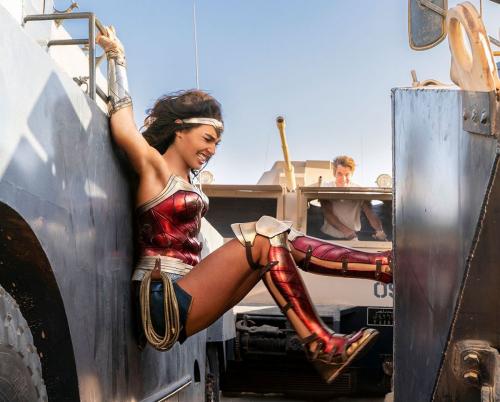
A chase on an open road in the Egyptian desert, suddenly dramatises how much Diana is losing her strength, while delivering a stunning showcase of stunts and special effects, as Wonder Woman tackles a military convoy. Fighting armed men in the White House, turns into a duel between the weakening Wonder Woman, and Barbara, who is now becoming a version of comic-book villainess Cheetah. Although Chris Pine’s role as Steve Trevor was sadly annoying in the previous movie, here his rather clingy character manages to play a worthy hero and later he’s a suitable inspiration for Diana to learn how to fly alone (no plane needed), with all the attainment of new poetic grace that her solo-flight implies.

Wonder Woman in her golden Amazonian armour, versus a vengeful Cheetah in were-cat form, makes the climactic battle spectacular as beauty against beastly. However, for the final confrontation, Wonder Woman wins by accepting her loss. She beats a now deranged Max Lord (his name evidently a cipher for maximum ‘lording it’ over humanity), by embracing a passion for truth, not fighting against a madman's voracious hunger for greatness. 

Heaven knows why the hell this sequel got such low ratings after its cinema release. Just a thoughtless backlash against movie-distribution problems caused by the pandemic? It’s a compelling drama of wish-fulfilment, where incautious requests soon prompt doomsday situations. Quasi-satirical villainy turns from a comedy of corruption and chaos to frame a magical mystery of how to put an unrestrained genie back into a bottle. Talking to people is clearly the only form of persuasion that actually works.

Gal Gadot is marvellous as Diana Prince, struggling to find and establish her place in this world where she doesn’t really belong. Of course, she’s magical instead of being a macho figure like Superman. She fights only to save her friend Barbara. In the end, she doesn’t even fight to save the world. Wonder Woman is honestly pro-democracy, and she simply urges everyone to make the right choice for themselves. Facing human extinction across the planet, “renounce your wish if you want to save this world” is her plea to be the best we can, no matter what we might desire.

Like all of the best superhero movies, WW84 has its fair share of inventive action scenes and so Diana’s glowing lasso catches a bullet in mid-air, she latches onto a handy rocket-launch, and then a lightning bolt, to swing through the sky. Max Lord is more like a spoof of Gordon Gekko (from Oliver Stone’s Wall Street), than a Latino variation of Lex Luthor. Pascal was in under-rated TV movie Wonder Woman (2011), playing the police detective. Lynda Carter (from Wonder Woman on TV, 1975-9), enjoys a cameo as legendary Amazon warrior Asteria. 

Extras on the bonus Blu-ray disc -

  • The Making Of Wonder Woman 1984: Expanding The Wonder
  • Gal & Kristen: Friends Forever
  • Small But Mighty
  • Scene Study: The Open Road
  • Scene Study: The Mall
  • Gal & Krissy Having Fun
  • Meet the Amazons
  • Black Gold Infomercial
  • Gag Reel
  • Wonder Woman 1984 Retro Remix